Guide

New resources for RTW Coordinators

Workers compensation provides a safety net for workers injured in the course of their employment, and employers play a crucial role in supporting injured workers return to work or stay at work while they recover.

Employers are obliged to appoint a Return to Work (RTW) Coordinator as per the relevant state legislative requirements to support both the employer and injured workers. The role of RTW Coordinators is vital to achieving positive outcomes for injured employees and includes:

  • implementing an organisation’s return to work program/information
  • preparing recovery and return to work plans
  • coordinating with medical specialists
  • checking on the worker’s recovery and their ability to return to work
  • monitoring the safety of job tasks when an injured employee returns to work
  • explaining the rights and obligations of injured workers to both the worker and employer.

We have a range of training, tools, coaching and a new collection of resources designed to support the important role that RTW Coordinators play in helping workers recover from injury and get back to work sooner.

Supporting RTW Coordinators

Training

EML offers a wide range of face-to-face and virtual training through our employer event program which are free for EML customers. We have also recently released the following online courses through EMlearning which coordinators may find helpful:

Videos

Managing workers insurance and personal injury claims can be challenging, so we’ve developed four helpful videos to assist in understanding your role in implementing your organisation’s return to work plan and supporting a worker’s recovery and return to work.

Identifying suitable duties in the workplace

If your worker is unable to resume their full duties, your role as the employer is to provide suitable duties and to assist them to return to work.

Providing suitable duties is an effective way to support your worker with their recovery and rehabilitation as it keeps them active and engaged with the workplace. It also minimizes time off from work and can help protect your business against rising insurance premiums.

Offering suitable duties is an effective way to aid a worker’s recovery and rehabilitation, by keeping them active and involved in the workplace. This approach reduces their time away from work, helps maintain business productivity, and can help protect your business from increasing insurance premiums. Once suitable duties have been identified in consultation with the key stakeholders, it is important to document these in a return to work plan to ensure a safe, timely and sustainable return for the injured worker.
Prolonged absence from work can lead to poor physical and mental health outcomes for the injured worker. It can also impact your business with loss of productivity, lowered morale and potential increases to your workers compensation premium. Therefore, the sooner an injured worker can safely return to work, the better the outcomes will be for all.
In most instances, a worker’s return to the workplace following an injury will be smooth and seamless. However, there may be occasions when return to work is delayed. This may be due to barriers from the worker, treatment provider or even the employer. There may even be concurrent barriers from multiple stakeholders. These barriers may be challenges or obstacles that can affect the worker’s recovery and ability to return to work.

Weekly benefits/income support factsheets

Access our range of colourful and easy to read collection of factsheets which have been designed to support employers in NSW, VIC and SA. They also include a helpful list of common definitions and notes to help clarify common industry terms.

From firefighter to fighter: Andrew’s journey through cancer

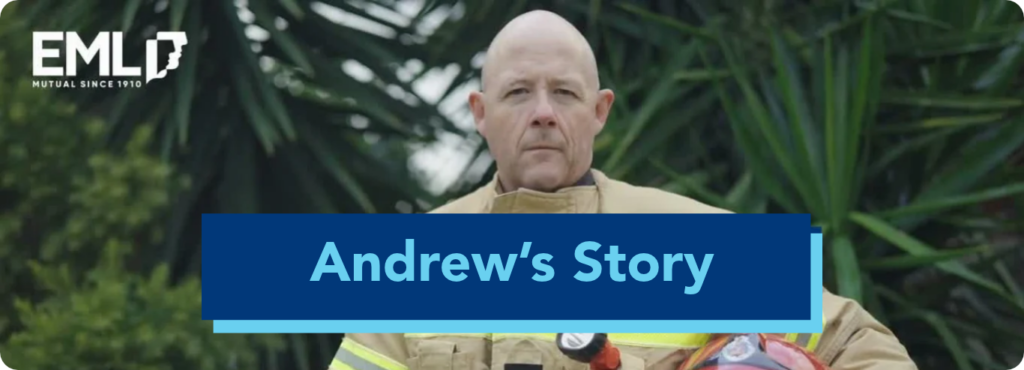
For Andrew Evans, Captain of Ingleburn Fire Station, service has always meant showing up when people need help most. Throughout his 28 years working as a firefighter, Andrew has faced smoke, danger and uncertainty. But nothing prepared him for the moment he was diagnosed with stage four oesophageal junction cancer. After experiencing occasional head spins, he didn’t think they were a sign of anything serious. However, blood tests revealed very low iron levels, leading to further investigations and a diagnosis that changed everything. At first, Andrew was told surgery was unlikely to be an option. But he wasn’t ready to accept that outcome. “I didn’t want a team managing my decline. I wanted a team willing to fight with me,” Andrew said. “That’s when EML came into my life.” Finding hope Once his case was submitted as a workers compensation claim, Andrew told his EML Senior Case Manager, Alisa C. [LC1.1]that he wanted a second opinion. She acted quickly to make it happen. Working closely with Fire and Rescue NSW (FRNSW) and Andrew’s treating team, Alisa coordinated the approvals needed to explore every possible pathway. That second opinion changed everything. Following major surgery with a specialist surgical team and ongoing treatment, Andrew received the news he and his wife, Kim, had been hoping for. His latest scan showed no evidence of disease. The human face of the policy Andrew’s claim was accepted under NSW’s Presumptive Legislation, introduced under the Workers Compensation Act 1987 to make it easier for firefighters diagnosed with certain cancers to access treatment through workers compensation. Under the legislation, if a firefighter develops one of the listed cancers after a qualifying period of service, the disease is presumed to be work-related. EML has managed workers compensation claims for FRNSW for over 15 years, a partnership that reflects our ongoing commitment to helping those who help others. Recognising the complex needs of firefighters and their families following a cancer diagnosis, we created a dedicated specialist team that supports firefighters with cancer claims and enables access to our Cancer in Care package. Developed in collaboration with FRNSW, the Cancer in Care package brings together tailored services throughout treatment and recovery. It includes physical and occupational rehabilitation, psychological support, counselling, support in the home and, in some cases, accommodation near treatment facilities. For Andrew, Kim became his primary carer. The assistance they received helped ease the pressure during an incredibly difficult time. “The support meant we could focus on survival, not paperwork,” Kim said. High-touch, seamless care For Alisa and the team, the work goes well beyond claim administration. “Pre-empting things is what we’re really good at.” “When someone is fighting cancer, everyday matters,” Alisa said. “Our role is to act with urgency, compassion and care so the person and their family feel supported through one of the hardest times of their lives.” Andrew is now rebuilding his strength and working towards returning to the role he loves. He has also used his experience to speak with other firefighters about cancer awareness and the importance of seeking help. Andrew’s story reflects what is possible when legislation, medical care, employer support and claims management work together with a shared purpose. For firefighters like Andrew, that support can mean more than access to treatment. It can mean hope, time with family and the chance to keep moving forward.

Not the insurance career you imagined

At EML Group, our Technology team is shaping the future of personal injury claims management and creating career opportunities that people don't expect.

Leading Well at Work: Leader Series Launch

The Leading Well at Work series is a practical, seven-part leadership program focused on the real challenges leaders face every day. It equips leaders with the knowledge, tools and confidence to support their teams, manage psychosocial risks, and lead in a way that promotes wellbeing and performance.
celebrating 5 years mobile case management

Celebrating 5 years of mobile case management across NSW

EML Group is proud to celebrate five years of delivering Mobile Case Management across New South Wales, marking a significant milestone in how claims support is provided to injured workers, employers and providers.

EML Secures ACT Government Contract Renewal Through to 2037

EML has been reappointed as the ACT Government’s dedicated claims administration partner, extending a long-standing collaboration focused on delivering strong outcomes for ACT Public Service workers.

How EML is using AI to improve claims outcomes

AI at EML Group is not new. We have applied machine learning in our claims platforms for over a decade to automate high volume tasks such as document classification and processing.

Share :

Top resources

Leading Well at Work: Leader Series Launch

EML is proud to launch the Leading Well at Work leadership series – designed to build...

Workplace & Leader Toolkits

These toolkits have been developed to turn insight into action. They provide simple, evidence-based ways for...

NSW Reforms in Practice webinar series

With the most significant changes to the NSW Workers Compensation Scheme in a decade, we have...
Other resources